
Please ensure Javascript is enabled for purposes of website accessibility

Geology A Level

student looking through a microscope
Getting Ahead

Geology A Level at Havant Campus

Geology is the study of the earth, investigating ideas and theories using keen observations and evidence collected analysis with a scientific approach and evaluating the findings.

We study a rich variety of topics about the planet and explore from the smallest minerals to the most destructive volcanoes, to the hidden mysteries that cause movements in our crust. We know most about our surface and the rocks that make up this rigid lithosphere, so that is where we will begin.

We have put together the following ‘Getting Ahead’ work to help you prep for your course over the summer.

We look forward to you starting College with us soon!

Follow us on Instagram @hsdcgeology
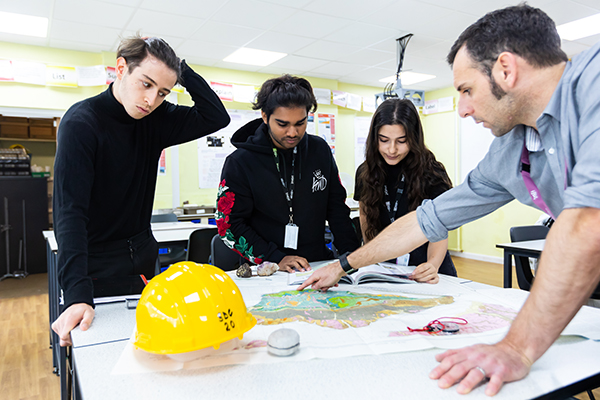
students around a table in class with a lecturer

Geology often involves unknown elements with some clues and piecing together a story like a good detective. For example, working backwards to the origin of a rock, how it was formed and the journey it has taken.

The planet in a pebble: Your story of a pebble. Find a pebble and write its story/journey.

Here are some questions to help guide your story:

  • How did it form?
  • Where might it have come from?
  • Does it have distinct colours/shape – what do these represent?
  • What are the main rock types in your area?
  • Could it have been transported somehow?
  • How has it changed through time?
  • Where did you find it and how did it get there?
  • What else was there in the location you found it that might help explain this?

Try to use some scientific ideas/processes and terms. If you are struggling, I recommend looking at the rock cycle and you could start the story with “a long, long, time ago…”.

There are lots of free online resources but this has been written for Geology students across the world and is an excellent read (you do not have to read it all).

Exploring Geoscience Across the Globe – free textbook

P.33-62 is about rocks and processes which should also help with the pebble activity.

Men of Rock is a great series based on how geology was studied and how it has progressed looking at the landscape of Great Britain, famous locations, evidence and geologists like Hutton and how they influence the subject today.

Part 1: Deep time

Watch the documentary above to answer the following questions:

  1. Where is the most ancient landscape in Great Britain? 
  2. Who is the founding father of Geology? 
  3. What did Hutton think provided power to the earth?
  4. What problem did Hutton face regarding molten rock? 
  5. How are crystals formed? 
  6. How are large crystals formed and what type of rock might form? 
  7. How did Hutton propose sedimentary and Igneous rocks form? 
  8. What was special about Siccar point? 
  9. What was Hutton not aware of that had happened in Scotland’s past? 
  10. How old were the rocks at Siccar point? 
  11. What was the key idea in his theory? 
  12. What method did Kelvin use, and what was his starting temperature?
  13. How old did he calculate the earth to be? 
  14. What error had he made? How did the rocks reveal the truth? 
  15. What is the oldest rock in Scotland? 
  16. What crystals were used to date it? 
  17. What radioactive element was decaying and could be measured? 
  18. How old was the Gneiss? 
  19. How old is the earth?

Part 2: Moving mountains

Watch the documentary above to answer the questions below, then continue trying to pick out more key information with 5 additional bullet points.

  1. What was the simple logical idea for Scotland’s landscape, How did the sea stack show this?
  2. What was wrong with this regular succession theory of old to young rock at the top?
  3. How did the older rocks get on top of the younger ones?
  4. What was found in the caverns and what did these show?
  5. Why were the type of trilobites found in Scotland so significant?

Part 3: The big freeze

Watch the above documentary, and pose your own questions as you go. Write a series of bullet points summarising the important parts.

We look at rocks under the microscope!

We can take a rock sample and slice a thin section analysing it under a polarising microscope to investigate its minerals and history of formation. For example, if it’s an igneous rock we can investigate how quickly it cooled, what type of magma formed it and suggest the type of plate boundary even if there was water present!

Take a look at this link. Explore and find out more. We use these in practical work in our bespoke geology lab at HSDC Havant.
*This is a representation of your learning space and may not be the exact room you will be using

College is definitely worth all the effort you put in, you get to meet lots of different people and it’s amazing.

Ebony Puttock, A Level student

“HSDC provided me with the opportunity for autonomous study and the choice of subjects that I wanted to study, which helped me develop relevant knowledge as well as relevant skills for the workplace.”

Lucas Ratcliffe, A Level and CTEC student

My experience at the College was great, it’s very different to school, and I think it’s a good step to going to university. The support was amazing, I loved all of my teachers, they helped me through everything. The College is friendly and you will succeed.

Heidi Adamson Brattland, A Level student