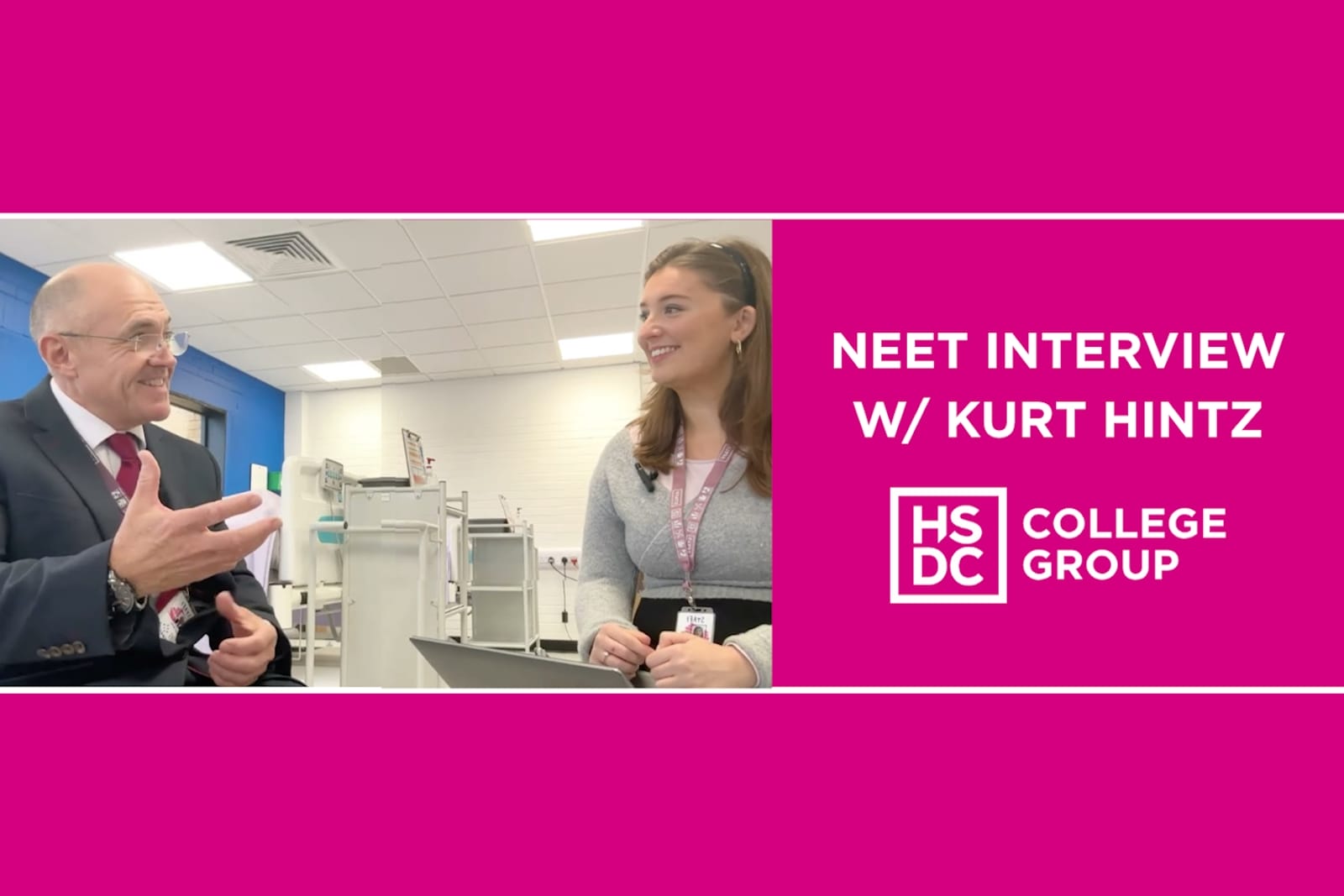
Abbie sat down with Kurt Hintz, Principal and CEO of HSDC College Group, to talk about NEET: young people who are not in education, employment or training.
Around one in 20 young people in our region are NEET at 16 to 18, and that rises to around 1 in 10 at 18 to 24. Kurt explains what HSDC College Group is doing about it.
Content Summary
Kurt explains that the problem isn’t a lack of jobs. Too few people have the skills employers need.
To help close that gap, HSDC College Group is:
- Helping more employers take on apprentices
- Offering new construction courses at South Downs College and Alton College
- Making sure every subject has a starting point at Level 1, whatever your GCSE results
- Running T Levels with long work placements that often lead straight into jobs
- Supporting students closely in their first few months, with the chance to switch courses if it isn’t right
- Using mentors to step in early when a student starts to struggle
- Launching short evening courses for adults and more chances to start partway through the year
This is a simplified summary, please watch the full video for further information.
Watch the video below:
Transcript:
Abbie: Hello, my name’s Abbie. I’m a Marketing, Communications and Content Officer here at HSDC College Group, and I’m joined by our Principal and CEO, Kurt Hintz.
Kurt: Hello everyone, welcome.
Abbie: We’re going to be discussing the issue of NEET – not in education, employment or training. So, Kurt, what really is NEET?
Kurt: NEET is a categorisation of people, young people especially, who are not currently in education, employment or training. That categorisation is usually for 16 to 18-year-olds, so post-16, after they’ve left school. But we widen that and look at 16 to 24-year-olds too, as a wider group of people who can also be not in education, employment or training. That might be people who have gone on to a college course or something else, finished it, and then not gone into employment, not been able to find employment, and not gone into any other training.
Abbie: So what is HSDC College Group currently doing to support those who are at risk of becoming NEET?
Kurt: In this region, and nationally, there’s a big problem with the number of young people becoming NEET. That includes those who come out of school and don’t go into a college environment or any post-16 education at all. At the moment that’s around 5% in our region, which is high. That’s one in 20 young people who are not in any form of education or employment – they are ultimately doing nothing. If you look at 18 to 24-year-olds, it rises to around one in 10. So these are really big numbers, and they’re getting worse. That’s been recognised by government, in a lot of reports and in the things government is doing to help support people into employment.
We’re working on all of those agendas, and one of the big ones is offering many more apprenticeships and getting more employers to take on apprentices, because there genuinely aren’t enough apprenticeships for all the people who would love to do one and who are skilled and qualified to do one.
We’re using all the different incentives available to help employers take on apprentices. For example, employers sometimes don’t know that they pay no National Insurance contributions when they take on a young apprentice. And if the apprentice is 16 to 18, there are significant financial benefits – employers can get a significant contribution towards the cost of that training, in some cases up to £4,000. So there are some really big incentives, and we make sure employers know about them. We support them to recruit apprentices, and we train those apprentices throughout their programmes as well. Apprenticeships are a really big driver in helping people take that first step into employment and then continue on their journey.
The key thing driving the NEET profile, especially post-18, is that the job market isn’t matched to the skills people have. That’s where apprenticeships can really line things up. It’s not that there aren’t enough jobs – it’s that there aren’t enough people with the right skills to go into those jobs. So the training we deliver is all about giving people the right technical skills to get into the jobs on offer.
Apprenticeships are one part of that. We’re also widening the provision we offer. At South Downs College, we’re now offering construction at Level 1, moving into Level 2 next year. That’s skills-based training, and there are many vacancies in the construction sector – employers are crying out for people, saying they simply can’t find enough skilled workers. You can see that misalignment between skills and the job market, so we’re actively trying to support that. We’ve also opened construction provision at Alton College, and we’ve put over a million pounds into those construction facilities so students train in industry-standard facilities.
We also have a very wide range of programmes for those who perhaps didn’t do so well at school and didn’t find something post-16. In every sector, we offer entry at the lowest level, Level 1. So if you didn’t do so well in your GCSEs, you still have an access route into any sector you want. That’s really important for giving people the opportunity to get engaged in those different sectors.
There’s also a lot going on around offering people the chance to start at different points in the year. We’re launching a very large adult education offer very shortly, with short evening courses. Anybody aged 19 or over can take part – perhaps three hours a week in the evening – to gain skills that get them ready for their next job. And if you’re already in work, it can give you skills, such as AI skills, that enhance your job opportunities in the future.
Abbie: I imagine the T Levels would really help with that too, because I know a lot of T Level students go on to be employed by their work placements.
Kurt: T Levels are such a great example of matching the skills people have to the job market. You’re exactly right – they’re so well matched to industry. Students do more than 45 days on a work placement and complete industry projects, and by the time they get through the two-year programme – in engineering, for instance – all of those students have a job, with their employers waiting for them at the end of the programme. That shows how well matched they are, and it’s a great example of qualifications that absolutely match the needs of the job market.
Abbie: So how does the college identify students who may be at risk of becoming NEET?
Kurt: We have a range of different ways. Students come to us with a profile – how they’ve attained at school, what their attendance has been like, and whether they have a history of not engaging particularly well with education. Those students are at the highest risk of disengaging again post-16, because when you come into post-16 education there are a lot more freedoms. It’s not like school. Sometimes that doesn’t work out, and young people can become disengaged because they have so much more freedom.
So it’s about supporting them through that process, especially the transition in the first three months, making sure we’ve engaged well with them and they have a really good, close relationship with their teachers. All of our teachers are industry professionals – industry first, teacher second. They’re not like school teachers; students call them by their first name, for instance, and they bring their experience from the workplace into the classroom, which is often very engaging for young people. If we can hook them in during those first few months and they stay with us, they’ll be successful. Almost all of our students who stay the year are successful in their qualifications.
Abbie: And I suppose part of that is allowing them to change courses if they’re not happy, so they find the right place for them here rather than disengaging completely.
Kurt: Absolutely. We use that term all the time, don’t we – “right course, right student”. It’s one of those mantras we drive in that first period, making sure students have made the right choice. In the first six to eight weeks, students can change programme if they’ve chosen something that’s not for them. That’s absolutely fine, and we have a process in place for switching in those first six weeks.
Abbie: Looking beyond college, I know we have quite a big careers department here. Do they continue supporting students after they’ve left?
Kurt: That’s what the careers advice and guidance team is all about. We expect all of our students to do work experience alongside their course, and we have a work experience team who help them find a placement. It’s not just work for work’s sake – it’s in the sector they’re planning to go into. That’s at least two weeks, and T Level students do 45 days, which is far longer – some nine to 10 weeks. In some other areas, students do substantially longer placements, but we expect every student to do one. That’s the first step in engaging with a sector, getting to know it and thinking, “Okay, this is for me, and this is the specific role in that sector I’m thinking about.”
Our careers team can then advise and support them, whether that’s choosing the right university or going into employment, and help them secure an apprenticeship if they can find one. As I mentioned, there aren’t enough of those, and they’re very competitive. One of the things that team is really good at is helping students choose the right university. Of all the students who got a university place last year, more than 90% – I think around 95% – got their first choice.
Abbie: That’s really good. Is HSDC College Group planning to introduce any further measures to stop the number of young people becoming NEET from rising, or to reduce it?
Kurt: Yes, exactly that. As I mentioned before, there are the very short courses for adults – lots of different types of training, everything from construction to health and care. We’ll be offering a very full range of short courses that introduce different sectors. That might suit someone in that 18 to 24 group who did a full-time course but hasn’t yet found employment in that sector and is wondering what’s next. Short, 20-hour taster programmes can help guide them into their next steps and give them some really critical skills to support them into those jobs.
We’re also giving students who perhaps didn’t do so well at school, and who may have dropped out of college, the opportunity to join at any time in the year. If they drop out of a college course halfway through the year, they’re not stuck until the following September before they can re-enrol. So we’re making sure there are opportunities to step in at any point. And of course, we’re widening our skills offer so it’s better matched to the job market.
Abbie: Are there any provisions during the two or three years students are here that can help identify a student who may be slipping off the radar and becoming a hidden NEET?
Kurt: Yes, we use really intensive support and monitoring systems in the college. If a student’s attendance starts to drop off, which is a really key indicator that they may be disengaging, we support them heavily. We have lots of support in the college, such as student support mentors who work with students really intensively if they fall into that amber category – a warning sign, whether that’s attendance or personal issues they’re having. We make sure that support is in place, with a mentor engaging with that student, perhaps every week if necessary, to help them get over the issues they might be having.
Abbie: And just to finish off, what would you say is the most important thing HSDC College Group can do to make the biggest difference?
Kurt: I think it’s making sure we have a full and wide offer that supports students at any stage of their career – whether that’s right at the beginning, taking their first step at the very earliest Level 1, right up to the Level 3 provision we offer – in all of the sectors needed to support jobs in this region. The second part is matching the skills they learn to the job market. I’ve said how critical that is. So those are probably the two things.
Abbie: Thank you so much. That was all really interesting.