Book your place on our of our brand new FREE adult evening courses! Valuable skills in everything from Photography to First Aid, all free of charge.
Click here to find out more
|
||||||
This two-year course is equivalent to one and a half A Levels and is designed for students who want to develop their skills as performers alongside other subjects.
The Performance Pathway introduces you to a broad range of practical and creative activities, including solo and ensemble performance, composition, critical listening, and contextual study of different musical styles. You’ll explore rehearsal techniques, musicianship, and stagecraft, while also gaining insight into the music industry and professional practice.
Learning is structured through eight units, with the course culminating in a collaborative performance project. This gives you the chance to apply all the skills you’ve developed, working as part of a team to produce and deliver a live performance. The course provides an excellent foundation for progression into higher study, conservatoire training, or creative industry pathways.
Five GCSEs at grade 4 or above including English Language, as well as an audition that requires you to demonstrate that you are advanced enough on your instrument/ voice to start rehearsing with a band.
The UAL Diploma consists of eight units. Units 1 – 7 are skill-building units that prepare you for Unit 8, which is your final major project (FMP):
The facilities on our campus feature the latest music industry-standard equipment. They include:
Two Apple Mac (2017 iMac) production suites consisting of more than 20 individual workstations with audio keyboard and Logic X
Main recording studio consisting of Apple Mac Pro (2017)
Live music venue with a variety of live audio equipment: industry-standard microphones and DI boxes, PA and monitor speakers and outboard equipment – e.g. dbx compressors, lexicon FX .
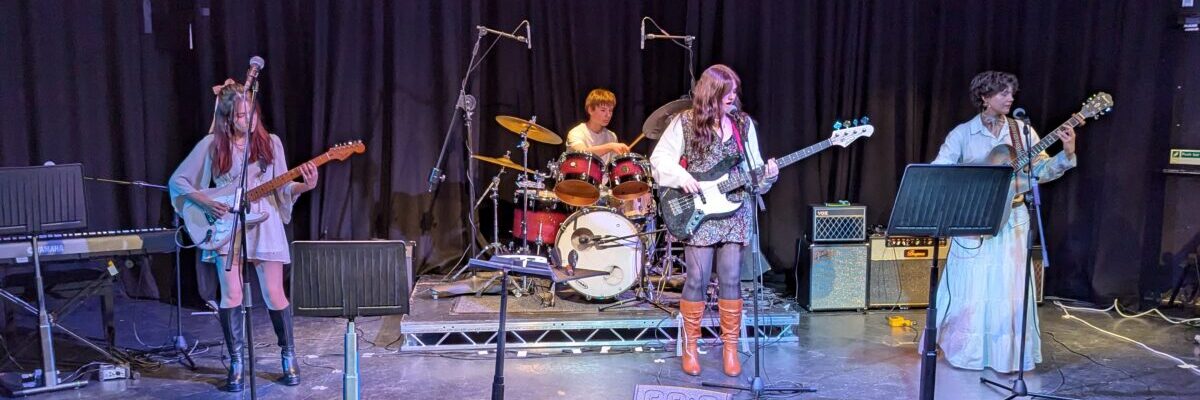
Our rehearsal room is equipped with all the kit required to rehearse and perform your favourite music:
Just rock up and start to learn tracks in a range of ensembles, from solo acts to full bands.
Our fantastic Ormond Room is a fully equipped performance space for recording or performing original songs or covers. Writing and performing music is at the heart of what we do throughout the courses here.
You will be continually assessed on a Pass or Fail basis on Units 1 – 7. The final Unit 8 will be graded on a Pass, Merit, Distinction level. The work towards your final unit will begin towards the end of term 1 in your second year.
On completion of this course, you could go onto university to study music further. You could also progress to become a performer, technician, promoter, venue manager, live sound engineer, songwriter, composer, music producer, studio engineer, musicologist, music therapist, peripatetic teacher or classroom teacher.