HSDC Havant has recently celebrated the hard work and dedication of its Extended Project Qualification (EPQ) students during a presentation showcase, underlining the College’s commitment to high aspirations, outstanding outcomes and a vibrant culture of independent learning.
The EPQ is an advanced, student-led research or artefact project, that helps students to explore their passions, deepen subject expertise and develop independent learning skills that will help them thrive at university. The qualification typically involves a substantial independent project (either a 5000-word essay, or a creative artefact) chosen by the learner, culminating in a presentation to their peers.
HSDC’s strong supervisory support, expert teaching and rich extracurricular landscape means that students develop not only subject-specific insight, but the transferable skills of communication, planning, evaluation and research skills that are highly valued by both employers and universities. These strengths are reflected in Havant’s exceptional outcomes, with 89% of EPQ students achieving grades A*-B last year, underscoring HSDC’s commitment to high aspirations and excellent progression results.
Hazel Aspden, Havant’s EPQ Coordinator, spoke passionately about the value of an EPQ in preparing students for their future plans:
“The Extended Project is a fantastic opportunity for students to hone their academic skills ready for university. However, it is an incredibly enriching course for all students, regardless of their future plans, as it nurtures key life skills: independence, organisation, self-reflection and communication.”
Over the course of the Spring Term, Havant’s EPQ students have presented their projects to their peers, offering them the chance to develop their public speaking and presentation skills whilst reflecting on their months of hard work.
Issabell Trigg produced a Watership Down based artefact for her EPQ.
Issabell Trigg produced an artefact for her EPQ, a collection of artworks that highlight the presence of folklore and mythology in Watership Down. Issabell’s original character designs demonstrated sophisticated artistic techniques, and she explained how she was able to overcome various challenges that she faced during the process, such as paint warping. She was able to demonstrate reflective practice, problem solving and project planning – the same analytical and evaluative skills that universities value in both creative and academic disciplines.
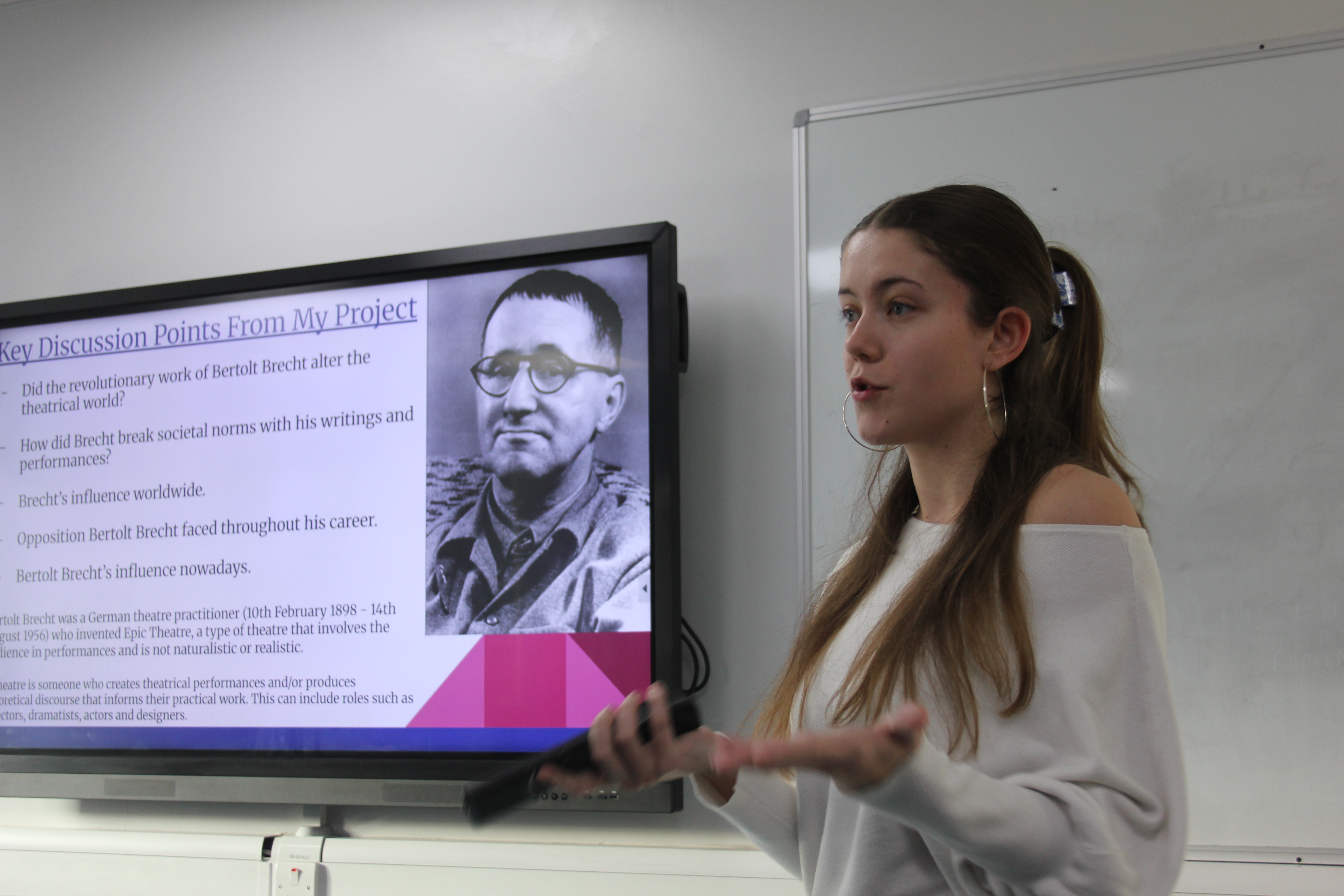
Ellie Carter wrote a substantial essay that asked ‘Did the revolutionary work of Bertolt Brecht alter the theatrical world?’. To answer this question, Ellie evaluated Brecht’s innovations in theatre, from breaking the fourth wall to deliberately exposed costume changes, which required synthesising complex theories, comparing practitioners and applying structured academic referencing. Ellie’s ability to condense long research texts and master Chicago-style footnotes aligns directly with the independent study skills required for degree-level writing, as well as demonstrating valuable communication and reasoning ability that are highly prized by employers in media, arts and cultural sectors.
When asked if she faced any challenges during this process, Ellie said:
“Being restricted to a word limit was a struggle, but I was able to eventually summarise large bodies of information and condense this into key points I can analyse. Using Chicago Footnotes was also a great thing to learn, I can use everything I learnt from this project in my own A Levels and beyond at university!”
Navy Henning examined the gender roles of the Ancient Greeks.
Navy Henning presented findings from their essay which sought to explore gender roles and expectations in Ancient Greece, and how these applied to the Gods. This required extensive critical analysis, evaluation of conflicting interpretations, and most importantly, the use of primary sources such as The Iliad and The Odyssey. By asking these important questions about the defiance of gender roles in Ancient Greece, Navy developed an understanding of the importance of critical thinking in academia, a vital skill that is much sought after at university.
Sebastian Balestrini designed a fashion collection in honour of Vivienne Westwood.
Sebastian Balestrini opted to produce an artefact for his EPQ – a fashion collection in honour of the memory of iconic designer Vivienne Westwood. His project followed five key stages – planning, researching, designing, creating and photography – resulting in 12 initial sketches, of which four were fully constructed into functional items of clothing. Drawing on Westwood’s punk influences and historical references, Sebastian spent several months developing the garments, noting substantial improvements in his sewing techniques and artistic confidence, both of which are crucial for honing resilience in a highly competitive industry.
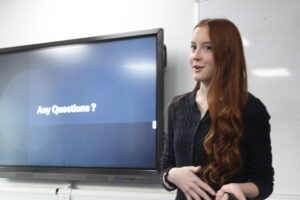
Hannah Taylor produced a research-based EPQ on Parkinson’s Disease.
Hannah Taylor’s research-based EPQ explored whether medical advancements can improve the quality of life for individuals living with Parkinson’s disease. Motivated by personal reasons and her ambition to continue these studies at university, she broke her project into focused research questions on symptoms, daily challenges and holistic intervention. Hannah’s outstanding work here mimics that of a biomedical researcher in higher education, echoing her ambitions and providing her with invaluable insight and experience into the expectations of a university student.
Speaking about her thought process behind the project, Hannah said:
“Planning it out in stages was one of the best ways for me to understand how to approach the topic. I wanted to understand more about the daily struggles of those with Parkinson’s, as well as gain genuine research experience as I prepare to apply for university.”
The maturity, creativity and academic rigour on display by this year’s presenters was exceptional, and HSDC is incredibly proud of their achievements. This is an extracurricular activity that truly sets Havant’s students apart when applying for university or employment, instilling in them the confidence and technical ability needed to thrive in whatever path they choose to take.